Thursday, October 11, 2007
Monday, March 26, 2007
Systema Camping Trip
We got around to having a camping trip at Krause Springs this past weekend. Myself, the two Marks, Ricky, Gene, his wife Annla, and his two twin boys Jack and Elias showed up for the fun. When Mark and I showed up, Ricky, the other Mark, and Gene were already training. They were just doing some basic structure breaking work using a limited number of strikes. We did some variations and expansions of this drill for a bit. Training out in nature (well, mostly nature, the campsite was visible from the office, and there were bathrooms, and nice park benches) is just nice. Sometimes I forget how sterile indoor training areas really are and how they can sometimes cramp our style. Being outdoors seems to loosen inhibitions with respect to striking, throwing, and just movement in general. Two guys actually came by and asked us what we were doing. One of them seemed interested in wrestling with us (he said he was into submission grappling), so somehow me and Mark egged Gene on into wrestling with him. The guy was pretty big and muscly, but way too desperate and sloppy in his movement. Gene had him in an armbar after about ten seconds of letting the guy flop around a bit. He seemed relieved to hear that Gene had been doing BJJ since possibly before he was born.
After training we hung out for a bit then decided to do some Parkour (freerunning) around the woods. I wish I would have brought my camera along for this, but I think I would have had a little bit less fun. We started out around the springs down in the ravine. There were a lot of rocks and tree roots to jump around on as we avoided stepping in the water. We did a mildly serious study on running around in areas with sketchy terrain--integrating relaxed breathing and form, being able to observe objects in the distance while walking (i.e. using peripheral vision to help navigate the terrain), and what tends to happen when running speed is increased (more mistakes!). For our purposes, we never really got above a really fast walk, but things still got a little hairy with wet rocks and tree roots and shoes from misjudging certain obstacles. I found the most challenging feats to be commited jumps onto wet rocks or roots with steep angles.
As we made our way further into the woods beyond the springs, we came upon a thirty to fourty-foot cliff that seemed like it might be fun for climbing. There was a tree growing a foot or so away from the face of the cliff, so we all either just climbed up the tree or used the tree to ascend the face to a height of twenty feet or so. The cliff face was quite vertical, and the rocks were a bit loose in parts, so none of us ventured too far away from the support of the tree. We found another area that was a bit nicer for simple climbing, so all of us except Mark (he took a harder route a ways off, being the experienced climber he is) went up this way and hung out at the top for a few minutes. Climbing up this way was not particularly dangerous, there were a few questionable places, but nothing risky if we remained calm. I didn't find myself getting panicky or hesitant on the way up. Coming down was more interesting. I stayed calm and maintained my breathing, but I had to consciously apply myself in this respect. I noticed that as I became more relaxed, my natural climbing ability kicked in a little more efficiently. I scooted my body closer to the face. Footholds that were not entirely horizontal and had some loose rocks and dirt on them were approached carefully, but not with the kind of tension that will cause a quick and nasty slip.
After this we went back up to the campsite to get ready for a swim in the springs. The water was refreshingly cold. After a bit of swimming, we went back up to the campsite. Mark and Annla started getting the food ready while the rest of us ended up dueling with Jack and Elias using Mark's set of shinai and bokken. Having a kid swing a sword at you with all his might is interesting. In some ways it's more intimidating because the kid, if young enough, still believes that since we're three or four times his size, that we're invincible. So he swings with all his might and from the most unorthodox of angles. In addition to that we had to be careful not to hit their fingers (or keep them from hitting their fingers). At one point in time, when I was dueling one of the twins, Gene pulls him aside and whispers to him to start trying to hit my body rather than my sword. Protecting myself actually became pretty difficult after that! I'm glad they only had the shinai to attack us, otherwise I might have some nice bruises. Working with swords is always great fun.
That night, after resting and eating some ridiculously fantastic food prepared and supplied by Gene, Annla, and Mark, we did some more freerunning/Parkour to get to the swimming area. I noticed that because most of my blood was around my torso, being involved in the digestive processes, that I stayed quite warm in the water as long as I didn't have my chest in. Swimming around or standing in water above my chest became quite cold very quickly. I don't have the opportunity to get myself out in nature that often, so swimming at night in cold dark water was very and soothing peaceful in its own way.
After swimming, we pretty much just hung around the fire until we all eventually went to bed. I figured there wouldn't be any rain, so I just parked my sleeping bag near the fire and fell asleep pretty quickly. I awoke to some racket in the middle of the night, but went right back to sleep. Later that morning we realized that the racket was some racoons getting into our food that we left out. They had actually been sneaking around while we were hanging out by the fire that evening and had stolen a container of cookies while we weren't but ten feet away.
So, basically, we had a blast!

Annla shows up while Gene relaxes and Mark shows off his curves.

Gene and Mark swordfighting a pair of identically deadly opponents.

Martial artist of the emerging generation.

Gene sword fighting with his boys.

Hanging out a bit after training.
After training we hung out for a bit then decided to do some Parkour (freerunning) around the woods. I wish I would have brought my camera along for this, but I think I would have had a little bit less fun. We started out around the springs down in the ravine. There were a lot of rocks and tree roots to jump around on as we avoided stepping in the water. We did a mildly serious study on running around in areas with sketchy terrain--integrating relaxed breathing and form, being able to observe objects in the distance while walking (i.e. using peripheral vision to help navigate the terrain), and what tends to happen when running speed is increased (more mistakes!). For our purposes, we never really got above a really fast walk, but things still got a little hairy with wet rocks and tree roots and shoes from misjudging certain obstacles. I found the most challenging feats to be commited jumps onto wet rocks or roots with steep angles.
As we made our way further into the woods beyond the springs, we came upon a thirty to fourty-foot cliff that seemed like it might be fun for climbing. There was a tree growing a foot or so away from the face of the cliff, so we all either just climbed up the tree or used the tree to ascend the face to a height of twenty feet or so. The cliff face was quite vertical, and the rocks were a bit loose in parts, so none of us ventured too far away from the support of the tree. We found another area that was a bit nicer for simple climbing, so all of us except Mark (he took a harder route a ways off, being the experienced climber he is) went up this way and hung out at the top for a few minutes. Climbing up this way was not particularly dangerous, there were a few questionable places, but nothing risky if we remained calm. I didn't find myself getting panicky or hesitant on the way up. Coming down was more interesting. I stayed calm and maintained my breathing, but I had to consciously apply myself in this respect. I noticed that as I became more relaxed, my natural climbing ability kicked in a little more efficiently. I scooted my body closer to the face. Footholds that were not entirely horizontal and had some loose rocks and dirt on them were approached carefully, but not with the kind of tension that will cause a quick and nasty slip.
After this we went back up to the campsite to get ready for a swim in the springs. The water was refreshingly cold. After a bit of swimming, we went back up to the campsite. Mark and Annla started getting the food ready while the rest of us ended up dueling with Jack and Elias using Mark's set of shinai and bokken. Having a kid swing a sword at you with all his might is interesting. In some ways it's more intimidating because the kid, if young enough, still believes that since we're three or four times his size, that we're invincible. So he swings with all his might and from the most unorthodox of angles. In addition to that we had to be careful not to hit their fingers (or keep them from hitting their fingers). At one point in time, when I was dueling one of the twins, Gene pulls him aside and whispers to him to start trying to hit my body rather than my sword. Protecting myself actually became pretty difficult after that! I'm glad they only had the shinai to attack us, otherwise I might have some nice bruises. Working with swords is always great fun.
That night, after resting and eating some ridiculously fantastic food prepared and supplied by Gene, Annla, and Mark, we did some more freerunning/Parkour to get to the swimming area. I noticed that because most of my blood was around my torso, being involved in the digestive processes, that I stayed quite warm in the water as long as I didn't have my chest in. Swimming around or standing in water above my chest became quite cold very quickly. I don't have the opportunity to get myself out in nature that often, so swimming at night in cold dark water was very and soothing peaceful in its own way.
After swimming, we pretty much just hung around the fire until we all eventually went to bed. I figured there wouldn't be any rain, so I just parked my sleeping bag near the fire and fell asleep pretty quickly. I awoke to some racket in the middle of the night, but went right back to sleep. Later that morning we realized that the racket was some racoons getting into our food that we left out. They had actually been sneaking around while we were hanging out by the fire that evening and had stolen a container of cookies while we weren't but ten feet away.
So, basically, we had a blast!

Annla shows up while Gene relaxes and Mark shows off his curves.

Gene and Mark swordfighting a pair of identically deadly opponents.

Martial artist of the emerging generation.

Gene sword fighting with his boys.

Hanging out a bit after training.
Maya Deren
As their flesh once labored to bring forth flesh,
so the minds of the elders labor,
with like passion
to bring forth a mind.
By rites of initiation
they would accomplish
the metamorphosis of matter into man,
the evolution of a mind for meaning in the animal
which is the issue of their flesh.
By this
they would insure that the race endure
as a race of men.
The rites of this second birth
into the metaphysical cosmos,
everywhere mime the conditions of
the first physical birth.
The novice is
purified of the past
relieved of possessions,
made innocent,
placed nascent in the womb solitude. . .
The matter,
which is man himself,
and the myth of a race
are joined.
His solitary meditation
is a gestation
and, in the end,
a man emerges by ordeal,
to be newly named, newly rejoiced in.
- Maya Deren (1952)
so the minds of the elders labor,
with like passion
to bring forth a mind.
By rites of initiation
they would accomplish
the metamorphosis of matter into man,
the evolution of a mind for meaning in the animal
which is the issue of their flesh.
By this
they would insure that the race endure
as a race of men.
The rites of this second birth
into the metaphysical cosmos,
everywhere mime the conditions of
the first physical birth.
The novice is
purified of the past
relieved of possessions,
made innocent,
placed nascent in the womb solitude. . .
The matter,
which is man himself,
and the myth of a race
are joined.
His solitary meditation
is a gestation
and, in the end,
a man emerges by ordeal,
to be newly named, newly rejoiced in.
- Maya Deren (1952)

Monday, February 26, 2007
Tuesday, February 06, 2007
Various Types of Restricted Work
The last few times we've been meeting have involved restricting the way we do work in various ways. The only two we've explored at all so far have been using blindfolds and then typing up limbs in a few different manners. In a sense, a lot of the training we do involves restrictions for the purposes of studying a concept in a very clear and concise manner. This type of restriction allows for a strong focus on the concept being explored. For example, if we're doing work with headlocks, no other type of locks will be involved, or strikes. As we establish some comfort with the specific type of work, other elements will of course be thrown in, until we're back to just doing freeform type stuff. A lot of Systema drills work this way--gradually shifting in and out of focus to allow specific concepts to be tied into being able to use them in non-restricted situations.
The type of restricted work we've been doing, however, is for the purposes of exploring freedom outside of what's being restricted. For instance, when the vision is restricted, we can observe the differences in performance. There are elements of vision that are important that get taken away with the blindfold, and there are elements of vision that are unimportant (i.e. distracting) that get taken away with the blindfold. The blindfold helps differentiate between these two types of elements to truly see the purpose of vision in fighting. This concept is fairly timless: take away something so one can truly appreciate it. We also tied up legs and arms (also tied two people together using various limbs) in order to create some physical restriction. In tying someone's legs together, the question is raised, "what do I really use my legs for?". Grappling with my legs tied really made me notice and appreciate how much I use my legs for momentum. Grappling with my leg tied to someone else's really made me notice and appreciate the freedom I have in moving on my own.
There are of course other benefits to restriction other than simply the appreciation gained by removal. Being tied to somebody else really pushes the concept of sensitivity and respect for what another person is doing. When not tied together, a lot of their movement is non-threatening (i.e. they're not striking or attempting a lock). But tie yourself to that person, and all of their movement affects you. This whole process requires relearning movement with respect to another human body. Relearning is good, it teaches the brain to refactor things and gain deeper insight into other situations. Freedom is gained by having certain presumptions destroyed. I think the same goes for a lot of the restricted scenarios we attempt.
The type of restricted work we've been doing, however, is for the purposes of exploring freedom outside of what's being restricted. For instance, when the vision is restricted, we can observe the differences in performance. There are elements of vision that are important that get taken away with the blindfold, and there are elements of vision that are unimportant (i.e. distracting) that get taken away with the blindfold. The blindfold helps differentiate between these two types of elements to truly see the purpose of vision in fighting. This concept is fairly timless: take away something so one can truly appreciate it. We also tied up legs and arms (also tied two people together using various limbs) in order to create some physical restriction. In tying someone's legs together, the question is raised, "what do I really use my legs for?". Grappling with my legs tied really made me notice and appreciate how much I use my legs for momentum. Grappling with my leg tied to someone else's really made me notice and appreciate the freedom I have in moving on my own.
There are of course other benefits to restriction other than simply the appreciation gained by removal. Being tied to somebody else really pushes the concept of sensitivity and respect for what another person is doing. When not tied together, a lot of their movement is non-threatening (i.e. they're not striking or attempting a lock). But tie yourself to that person, and all of their movement affects you. This whole process requires relearning movement with respect to another human body. Relearning is good, it teaches the brain to refactor things and gain deeper insight into other situations. Freedom is gained by having certain presumptions destroyed. I think the same goes for a lot of the restricted scenarios we attempt.
Monday, January 22, 2007
Group Picture

A picture of the group after training. I will post a bit about what we did that day shortly.
Wednesday, January 10, 2007
Blindfold Work
I bought a new camera with some Christmas money and was able to get a little bit footage from last Saturday's training session. We decided to test out the blindfold a little bit more. I've decided to start a theme of sensory and psychological deprivation for the next few training sessions. This time we deprived vision. Next time I think I may exhaust our energy before training. Since none of us our certified instructors, we tend to approach training from an explorative approach. This most likely means we will stay within the bounds of what we can conceive, which will be fairly limited, but should allow for some improvement to the general foundations (movement, breathing, relaxation, form).
I didn't get any footage of us without the blindfold for a bit of contrast, but we definitely noticed that we work from a more relaxed standpoint with the blindfold on. Gene, who was filming for us, observed that we seemed unwilling to accept the presence of our aggressor. In other words, as the aggressor would come in for a grab, we would fight more than what the threat would call for. Apparently a lot of this fighting instinct came from being able to see the aggressor as he approached, as our work with the blindfold seemed to have more acceptance of the aggressor.
I also got a certified instructor to take a look at the footage. He noted that we were still being a bit too technique-oriented--not enough genuine movement. He also said he would have liked to see us escaping a bit before the attacker applied the hold or grab. In talking with him, I noticed that my last bit of work at the end becomes very greedy as I realize I have the elbow locked in a mildly clever way. I even unnecessarily throw my leg over him to keep him there rather than doing the work and moving on. Now, if we were practicing restraining our aggressor, this might have been ok. However, the other two times I am "attacked" I do the work and move on. A cop told me about the rule of assuming escalation. If there's one guy attacking, be ready for two more to attack. If a guy attacks with his fist, be ready for a knife or a gun. By locking and restraining my partner I am locking and restraining myself to some extent, making me an easy target for any other aggressors or concealed weapons.
Thursday, December 21, 2006
No System for Striking
Vladimir, in a rare moment, talked to Jake quite a bit about striking instead of just hitting him a lot. I was able to listen in, so I will try my best to paraphrase/reinterpret what he said. The two phrases that really got me are "There is no system for striking" and "our bodies do not belong to us". The first makes very clear sense with respect to striking, and the second is a bit more ethereal.
Not having a system for striking seems obvious. Strikes are an energetic concept that require a genuine approach instead of pre-fabricated techniques. The exercises in Systema approach striking in various manners, but what is important is simply optimal energy transference (and in taking strikes, optimal energy dispersion). A lot of concepts get thrown around with respect to Systema strikes such as "heavy hands", "full hands", "being at a comfortable distance", or just "being relaxed".
These concepts are well and fine, but they dance around the very bottom issue of energy transference. Watching the subtleties of Vladimir's structure when striking compared to someone unexperienced is amazing. There is no shock reverberation traveling back into his body--oftentimes he will just use an arm to strike (no movement in the shoulders, hips, etc.), and if you can't see his arm, you would never know he was hitting somebody (well, obviously the guy flailing to the ground as a result of the strike gives it away). At the highest level, striking is a uniform and appropriate mixture of gentleness and power, sensitivity and force, and relaxation and tension. He mentioned that when one learns how to strike well, they don't need to be strong to affect somebody with a strike. This is purely on a physical impact level. Add in the dimension of psychology to striking, and there are no foreseeable boundaries to effectiveness.
What he said about our bodies not belonging to us ties these concepts together. Our bodies are made up of material just like anything else in the universe. We cannot control them to the extent that we would like--we constantly pester Mother Nature for her secrets. The rocks just sit, the sun just shines, the ocean just moves--why can't we just hit someone?
Vladimir said that striking is just natural, but we try to possess it, make it our own, create systems for it, etc. I can feel the unnecessary tension in my own strikes, I restrict the energy by trying to force a stronger impact onto my partner. My muscle fibers contract and expand in all the wrong ways as I deliver the strike--myself thinking that I am in control of my body and all its inner functions. Yet fortunately my heart beats without my consent, and my digestive system does its duties without asking for my permission. Striking can work in the same manner--there does not need to be a thought process or technique involved, just hit. Structure, alignment, breathing--yes, stay aware of these things. What I find funny about myself is that I needed to intellectually learn the obvious about striking: keep the structure so bones don't get broken, don't strike hard surfaces with hard surfaces (e.g. knuckles and forehead), and all those things that say that I am too out of touch with my body and its nature to simply just strike someone.
But I will keep trying until I can get out of the way of myself and just let my body do the work.
Not having a system for striking seems obvious. Strikes are an energetic concept that require a genuine approach instead of pre-fabricated techniques. The exercises in Systema approach striking in various manners, but what is important is simply optimal energy transference (and in taking strikes, optimal energy dispersion). A lot of concepts get thrown around with respect to Systema strikes such as "heavy hands", "full hands", "being at a comfortable distance", or just "being relaxed".
These concepts are well and fine, but they dance around the very bottom issue of energy transference. Watching the subtleties of Vladimir's structure when striking compared to someone unexperienced is amazing. There is no shock reverberation traveling back into his body--oftentimes he will just use an arm to strike (no movement in the shoulders, hips, etc.), and if you can't see his arm, you would never know he was hitting somebody (well, obviously the guy flailing to the ground as a result of the strike gives it away). At the highest level, striking is a uniform and appropriate mixture of gentleness and power, sensitivity and force, and relaxation and tension. He mentioned that when one learns how to strike well, they don't need to be strong to affect somebody with a strike. This is purely on a physical impact level. Add in the dimension of psychology to striking, and there are no foreseeable boundaries to effectiveness.
What he said about our bodies not belonging to us ties these concepts together. Our bodies are made up of material just like anything else in the universe. We cannot control them to the extent that we would like--we constantly pester Mother Nature for her secrets. The rocks just sit, the sun just shines, the ocean just moves--why can't we just hit someone?
Vladimir said that striking is just natural, but we try to possess it, make it our own, create systems for it, etc. I can feel the unnecessary tension in my own strikes, I restrict the energy by trying to force a stronger impact onto my partner. My muscle fibers contract and expand in all the wrong ways as I deliver the strike--myself thinking that I am in control of my body and all its inner functions. Yet fortunately my heart beats without my consent, and my digestive system does its duties without asking for my permission. Striking can work in the same manner--there does not need to be a thought process or technique involved, just hit. Structure, alignment, breathing--yes, stay aware of these things. What I find funny about myself is that I needed to intellectually learn the obvious about striking: keep the structure so bones don't get broken, don't strike hard surfaces with hard surfaces (e.g. knuckles and forehead), and all those things that say that I am too out of touch with my body and its nature to simply just strike someone.
But I will keep trying until I can get out of the way of myself and just let my body do the work.
Wednesday, December 20, 2006
Respect the Distance
I've had the pleasure of being at Vladimir's school up in Toronto for the past few days. As always: there has been a flood of information to take in and plenty to think about with respect to future training.
One topic that I had the chance to talk with Vlad about was striking distance. I might have posted on this a little bit before--but working with Vladimir directly really drives the concept into it's full solidity. This distance is a "comfortable" distance for doing work, in this case striking. Vladimir said that people aren't typically used to this middle ground--they will either fight with at least some amount of fear or with a lot of aggression. Some will fight in sparring mode: staying a safe distance then moving in quickly for a kick or a jab. Others will fight aggressively, closing the distance, taking the fight to the ground, or overpowering the other person with strikes. In order to be effective with either of these two extremes and everything in between, the distance must be respected.
The specific drill we worked on today was a progression from some arm-only strikes. We ended with one person trying to grab and the other keeping the comfortable distance while doing a few quick and hopefully effective strikes. This distance is kept no matter whether the opponent is backing off or pursuing. In other words, keep this middle distance until the work is done. This distance is best seen by walking around your partner while they stand still and placing your fist on them. A good understanding of structural alignment and also of impact transferrance in strikes helps with this. By placing your fist on your partner with proper structure (straight spine, relaxed shoulders, not reaching for the strike, but not too close either), one can get a good idea of what will be an effective distance for striking. I know there are a lot of concepts involved in this concept of "middle distance", but the best way to describe it is just to find the most comfortable position.
Vladimir referred to this as "the warrior's distance". A warrior will fight at this distance because it allows the most freedom from too much fear or aggression. Two warriors, fighting against eachother, will still fight at this distance, and one will eventually prevail for whatever reason.
One topic that I had the chance to talk with Vlad about was striking distance. I might have posted on this a little bit before--but working with Vladimir directly really drives the concept into it's full solidity. This distance is a "comfortable" distance for doing work, in this case striking. Vladimir said that people aren't typically used to this middle ground--they will either fight with at least some amount of fear or with a lot of aggression. Some will fight in sparring mode: staying a safe distance then moving in quickly for a kick or a jab. Others will fight aggressively, closing the distance, taking the fight to the ground, or overpowering the other person with strikes. In order to be effective with either of these two extremes and everything in between, the distance must be respected.
The specific drill we worked on today was a progression from some arm-only strikes. We ended with one person trying to grab and the other keeping the comfortable distance while doing a few quick and hopefully effective strikes. This distance is kept no matter whether the opponent is backing off or pursuing. In other words, keep this middle distance until the work is done. This distance is best seen by walking around your partner while they stand still and placing your fist on them. A good understanding of structural alignment and also of impact transferrance in strikes helps with this. By placing your fist on your partner with proper structure (straight spine, relaxed shoulders, not reaching for the strike, but not too close either), one can get a good idea of what will be an effective distance for striking. I know there are a lot of concepts involved in this concept of "middle distance", but the best way to describe it is just to find the most comfortable position.
Vladimir referred to this as "the warrior's distance". A warrior will fight at this distance because it allows the most freedom from too much fear or aggression. Two warriors, fighting against eachother, will still fight at this distance, and one will eventually prevail for whatever reason.
Saturday, December 16, 2006
Sticks And Sticks Will Break My Bones
I brought the staff in today so we could have some fun with a capital F. Ricky didn't show up until later so Fabian and I started off with some staff striking warmups. Taking strikes with the staff is worlds apart from taking strikes with the fist. Staffs hurt the bones, bring sharper pain to the muscles, have a different effect on the nervous system. There is also a little more trust required of one's partner--that a shot to the chest won't bounce up and hit the chin or the neck, for example. We didn't hit too intensely though--at the very hardest only striking a little bit harder than what would allow the person being struck to keep their composure.
This striking drill gradually became a movement drill. We both started moving around while one person would get struck. The point of this drill was not so much evasion as it was moving the body in such a way that the strike would be the least damaging. This is another parameter to explore with respect to getting struck by anything--damage control.
This striking drill gradually became a movement drill. We both started moving around while one person would get struck. The point of this drill was not so much evasion as it was moving the body in such a way that the strike would be the least damaging. This is another parameter to explore with respect to getting struck by anything--damage control.
Sunday, December 10, 2006
That Guy Hits on Everyone
Today we began with some breathing/body warmups. We started out with one step per inhale/exhale (step/inhale, step/exhale) as we walked around the room. Making our way up to five or six steps per inhale/exhale, we went into a light jog. We peaked at ten steps per inhale/exhale and climbed back down to four steps. We talked briefly about the effects experienced during the warmup. Involuntary upper costal breathing (breathing only into the upper parts of the lung in a desperate attempt for more oxygen) seemed to happen to all of us a little bit in the higher stages. We all also begin to feel slight discomfort due to oxygen deprivation when jogging at six to seven steps per inhale/exhale.
Learning to relax in this drill is so much more than just a muscular, skeletal, or psychological concept. As is often repeated in Systema, breathing is not just the mechanical action of the lungs inhaling and exhaling. The inhale and exhale literally extend into the entire body. A proper breath involves physiological efficiency well past the scope of lung operation. The body must be relaxed in an internal level. Training on this level requires a little bit more sensitivity, but is hardly outside anyone's capabilities. Simple exercises such as feeling the pulse in certain parts of the body or performing a single pushup can open doors into the internal mechanics of the body.
After our warmup, we started into some striking work. There were four of us today, so we paired off and began with a basic fist and body alignment drill. One partner stands still while the other walks around that partner, placing their fists on different parts the person's body. This drill is great for feeling one's own structure and form with respect to the person they are striking. The endless contours of the body require that each part of the body be struck genuinely. After the fist placement drill, we started to do some fist pushing. This validates the concept of structure even further. One should try to push with the fist in such a way that they don't move backwards or forwards. In other words, the person being pushed should move, not the person doing the pushing. This is a dynamic balance issue that sounds a little boring from the outside, but a lot of fun to play with once you get into the structural issues.
We eventually got into some real striking. Jase showed up for the first time so I paired off with him so I could jabber a bit about these concepts while striking him and letting him strike me. I explained to Jase how our dominant side usually carries the most tension. I explained this after he noticed himself that his left side was much more tense in receiving strikes than the other. I also explained that certain types of trauma can affect how the body handles strikes. I have had some digestive issues for the past year or so that began with a few occurences of incredibly sharp pain (possibly pancreatitis) that would last for twenty-four hours (bad combinations of prior stress and combining the wrong foods with alcohol). So strikes in certain areas of my body are not received very well. I constantly made reference to breathing so he would get the idea behind being able to take a strike. I also showed him the full spectrum of muscular tension when receiving a strike. Being completely tense sends shock all throughout the body and may possibly result in muscular tissue damage, while being completely loose allows the strike to penetrate the interal organs resulting in a very sickening feeling and potentially some internal injury. So in just a few minutes he had some of the tools to start playing around with receiving strikes. He seemed to like these concepts and ran with them quite well as I continued to hit him.
We did another drill which Fabian accidently began by hitting me as I was hitting Jase. The concept of transferring the momentum/energy of a strike received into giving someone else a strike is similar to the game "hot potato". So at first we lined up and the person in the back of the line started out by striking the person in front of them. That person strikes the person infront of them, and so on. Every so often we would rotate. After doing this for a while, we modified it so that everyone in the line faced the person in the back of the line. So the person in the back of the line would strike the person in front of them, and that person would have to turn around to be able to strike the person in front of them, and so on so that by the time the end of the line was reached, we would all be facing the person in the front on the line. Then the person in the front of the line would strike the person in front (technically behind) them and start all over again. After this we did some strike avoidance drills until the kids showed up for their class.
Learning to relax in this drill is so much more than just a muscular, skeletal, or psychological concept. As is often repeated in Systema, breathing is not just the mechanical action of the lungs inhaling and exhaling. The inhale and exhale literally extend into the entire body. A proper breath involves physiological efficiency well past the scope of lung operation. The body must be relaxed in an internal level. Training on this level requires a little bit more sensitivity, but is hardly outside anyone's capabilities. Simple exercises such as feeling the pulse in certain parts of the body or performing a single pushup can open doors into the internal mechanics of the body.
After our warmup, we started into some striking work. There were four of us today, so we paired off and began with a basic fist and body alignment drill. One partner stands still while the other walks around that partner, placing their fists on different parts the person's body. This drill is great for feeling one's own structure and form with respect to the person they are striking. The endless contours of the body require that each part of the body be struck genuinely. After the fist placement drill, we started to do some fist pushing. This validates the concept of structure even further. One should try to push with the fist in such a way that they don't move backwards or forwards. In other words, the person being pushed should move, not the person doing the pushing. This is a dynamic balance issue that sounds a little boring from the outside, but a lot of fun to play with once you get into the structural issues.
We eventually got into some real striking. Jase showed up for the first time so I paired off with him so I could jabber a bit about these concepts while striking him and letting him strike me. I explained to Jase how our dominant side usually carries the most tension. I explained this after he noticed himself that his left side was much more tense in receiving strikes than the other. I also explained that certain types of trauma can affect how the body handles strikes. I have had some digestive issues for the past year or so that began with a few occurences of incredibly sharp pain (possibly pancreatitis) that would last for twenty-four hours (bad combinations of prior stress and combining the wrong foods with alcohol). So strikes in certain areas of my body are not received very well. I constantly made reference to breathing so he would get the idea behind being able to take a strike. I also showed him the full spectrum of muscular tension when receiving a strike. Being completely tense sends shock all throughout the body and may possibly result in muscular tissue damage, while being completely loose allows the strike to penetrate the interal organs resulting in a very sickening feeling and potentially some internal injury. So in just a few minutes he had some of the tools to start playing around with receiving strikes. He seemed to like these concepts and ran with them quite well as I continued to hit him.
We did another drill which Fabian accidently began by hitting me as I was hitting Jase. The concept of transferring the momentum/energy of a strike received into giving someone else a strike is similar to the game "hot potato". So at first we lined up and the person in the back of the line started out by striking the person in front of them. That person strikes the person infront of them, and so on. Every so often we would rotate. After doing this for a while, we modified it so that everyone in the line faced the person in the back of the line. So the person in the back of the line would strike the person in front of them, and that person would have to turn around to be able to strike the person in front of them, and so on so that by the time the end of the line was reached, we would all be facing the person in the front on the line. Then the person in the front of the line would strike the person in front (technically behind) them and start all over again. After this we did some strike avoidance drills until the kids showed up for their class.
Sunday, December 03, 2006
Irresistable Movement
We are finally back to a normal training schedule. Fabian and Ricky showed up on Saturday morning for about an hour of training. We did some lock/hold escaping drills based using the concept of "least resistance" as the basis for escaping. Two people would apply a lock on one person and hold the lock until that one person escapes. This drill is essentially an exploration of freedom while under the influence and possibly illusion of restriction. There is so much that can be explored, but the mind can come to a screeching halt when an already painful wrist-lock is torqued a little bit more or head/neck movement is restricted completely.
We started out doing this drill while standing, which typicall resulted in both arms and the neck being held or locked in some fashion. This gives room for a lot of default options with respect to movement: footwork, leg movement, and torso rotation can usually be employed. So in a sense, being locked up while standing allowed for some exploration in using these default options appropriately. Going to the ground creates less room for any type of movement, meaning there are few, if any, default options. In this setting, movement must be explored genuinely to take advantage of what little room one might have. Even a quarter of an inch of room (possibly less) will suffice to escape in some situations.
In addtion to moving from standing to the ground, we also begin reapplying locks and holds as soon as they were escaped until the drill became a grappling-type flow. Initially once the lock/hold was escaped, the person applying it would step away. But as we progress and the drill becomes a little easier, we increase the difficulty.
We started out doing this drill while standing, which typicall resulted in both arms and the neck being held or locked in some fashion. This gives room for a lot of default options with respect to movement: footwork, leg movement, and torso rotation can usually be employed. So in a sense, being locked up while standing allowed for some exploration in using these default options appropriately. Going to the ground creates less room for any type of movement, meaning there are few, if any, default options. In this setting, movement must be explored genuinely to take advantage of what little room one might have. Even a quarter of an inch of room (possibly less) will suffice to escape in some situations.
In addtion to moving from standing to the ground, we also begin reapplying locks and holds as soon as they were escaped until the drill became a grappling-type flow. Initially once the lock/hold was escaped, the person applying it would step away. But as we progress and the drill becomes a little easier, we increase the difficulty.
Thursday, November 23, 2006
Jake is Famous
My first martial arts training partner ever, Jake, has made it into the news for his study group in Utah. Here's the article.
Monday, October 30, 2006
Blindfold Work
Working with a blindfold seems a bit eclectic and Jedi-ish. This past Saturday only Fabian and I showed up for training, so I decided to let him have the hour and a half of training (I.e. I was the attacker--though there is some training insight to be gained from this role as well.) Fabian has been curious about defending himself from fast and aggressive attacks where the attacker is protecting himself and throwing a lot of strikes all at once. Training with this type of attacker is fantastic, as being able to handle this attacker requires a great deal of precision--precision achieved unconsciously, given the speed at which these attacks come.
There are a few simple drills to start with. Typically, someone attacking in this method will have a narrow focus and direction (Straight at the victim, keeping a razor sharp focus on where the victim is moving.) One way to think of this is to visualize a plane extending vertically from the attacker's spine to the victim's spine. The attacker will (in this instance) be facing his attacker directly. Now of course, there is no limit to how an attacker will act. Sideways, from above, as they shake your hand, etc., just be clear that anything can happen. We are training specifically for one type of attack. In order to handle this type of attack, one must recognize it genuinely, not simply treat an attacker in this manner based on false data. Vladimir wrote in his Handbook that it is ok to know who is attacking and to be somewhat ready for how they are expected to attack. However, equally understand the possibility that they will attack in an unexpected manner, no matter how bizarre. Watching Vladimir move with some of the feints and tricks people try on him is fascinating. He handles the attacks as uniquely as the attacker tries to make, or sometimes he'll just step to the side while scratching his head with boredom (or setting up a "russian bitch slap"--apparently Vlad will scratch his head, looking harmless, only to pivot from the waist, swinging the scratching hand around into a nice *thwap*).
Back to the drills. The plane extending from the spine. What one can work with first off is not getting targeted--I.e. staying off center from the attacker's focus. Even a few inches off the attacker's focus can be extremely ideal (in some cases more ideal than a few feet--subtlety can go a long way). A simple footwork drill:
I had Fabian face me, the attacker. I would walk towards him and have him walk backwards. As I followed him, he would change his direction any way he liked, being observant of how I would react. Then he would try some fakes--some will work, some won't. This drill alone is very complex if one is observant enough. Subtle weight shifts, eye contact cues, audible breathing, and other factors are all involved in this drill. We went slowly until we became bored, and then went slowly for a little while longer. We picked up the intensity for a little while before slowing down and adding strikes to the drill.
At first Fabian wasn't allowed to move away from the strikes. Only use his footwork and concentrate on keeping me misaligned from my attack. Then after this he can start to rotate a little bit to use his body to redirect strikes, duck or lean back to avoid, etc. Throughout the strikes, even while going slow, I tried to throw enough intensity to make visible any tension in his movement (I.e. eyes widening, jerky protective responses in the arms, sharp breathing). After only using his body for the strikes, he is now allowed to use his arms. We did this until we were moving at maybe %60-70 speed. Nobody got hurt. A few little jaw taps (Fabian is relaxed enough to let them just pass by) and one fun one where Fabian somehow managed to headbutt my fist quite effectively (making contact before I expected it, with ensuing finger bone cracks had we been going full speed).
For the second half of this session, I had Fabian work with a blindfold and essentially start these drills all over again. Though before I did that I did some striking work on him while he stood still. What's important in striking somebody while blindfolded is to bring out just enough fear to where they can understand what's happening to them. They should fear the next strike just a little bit (so be sensitive to what your partner needs, as always). This trains them to be able to take a surprise strike genuinely without seeing it. Sometimes vision can allow for preparation before the strike hits, sometimes vision can create too much tension. The trick is to let the vision have just enough priority in how one reacts. This goes for all the senses. If one sense crowds the rest, then the person may overreact to a stimulus in that sense, or they may lack the awareness of other stimuli in other senses. Balance is key. Reacting appropriately is also key, as every situation requires a uniquely appropriate reaction.
As I took Fabian through the blindfold work, he started to loosen up (working without the vision or some other restriction can be very relaxing, just like lying down after standing for a long time can be relaxing). At the end, I had him do some work on me (still blindfolded) while I tried to attack him. This drill has always puzzled me. Sometimes his movement was almost as if he could see my strikes, and other times he would run right into my fist. I think that, as the attacker, being impartial to what happens in this drill is important to see it from a genuine perspective. There is always a temptation to either help the partner out to much or to be too mischievous. A few other people in the past have avoided almost all of my strikes in the first half of the exercise. Then, as they took a few strikes here and there, their performance seemed to degrade, and tension ensued.
After about maybe a half hour of blindfold work, I had Fabian take off the blindfold and do some more work, observing any differences in his performance. He was amazed to find that he was more relaxed in handling my strikes. In his case, his vision was causing him a lot of unnecessary tension. I was amazed as well. I haven't done a whole lot of blindfold work with people, and when I do, it's usually not in this gradual type of drill progression. Seeing the difference in his performance was good training for me--reinforcing some of these basic concepts with the body and nervous system.
There are a few simple drills to start with. Typically, someone attacking in this method will have a narrow focus and direction (Straight at the victim, keeping a razor sharp focus on where the victim is moving.) One way to think of this is to visualize a plane extending vertically from the attacker's spine to the victim's spine. The attacker will (in this instance) be facing his attacker directly. Now of course, there is no limit to how an attacker will act. Sideways, from above, as they shake your hand, etc., just be clear that anything can happen. We are training specifically for one type of attack. In order to handle this type of attack, one must recognize it genuinely, not simply treat an attacker in this manner based on false data. Vladimir wrote in his Handbook that it is ok to know who is attacking and to be somewhat ready for how they are expected to attack. However, equally understand the possibility that they will attack in an unexpected manner, no matter how bizarre. Watching Vladimir move with some of the feints and tricks people try on him is fascinating. He handles the attacks as uniquely as the attacker tries to make, or sometimes he'll just step to the side while scratching his head with boredom (or setting up a "russian bitch slap"--apparently Vlad will scratch his head, looking harmless, only to pivot from the waist, swinging the scratching hand around into a nice *thwap*).
Back to the drills. The plane extending from the spine. What one can work with first off is not getting targeted--I.e. staying off center from the attacker's focus. Even a few inches off the attacker's focus can be extremely ideal (in some cases more ideal than a few feet--subtlety can go a long way). A simple footwork drill:
I had Fabian face me, the attacker. I would walk towards him and have him walk backwards. As I followed him, he would change his direction any way he liked, being observant of how I would react. Then he would try some fakes--some will work, some won't. This drill alone is very complex if one is observant enough. Subtle weight shifts, eye contact cues, audible breathing, and other factors are all involved in this drill. We went slowly until we became bored, and then went slowly for a little while longer. We picked up the intensity for a little while before slowing down and adding strikes to the drill.
At first Fabian wasn't allowed to move away from the strikes. Only use his footwork and concentrate on keeping me misaligned from my attack. Then after this he can start to rotate a little bit to use his body to redirect strikes, duck or lean back to avoid, etc. Throughout the strikes, even while going slow, I tried to throw enough intensity to make visible any tension in his movement (I.e. eyes widening, jerky protective responses in the arms, sharp breathing). After only using his body for the strikes, he is now allowed to use his arms. We did this until we were moving at maybe %60-70 speed. Nobody got hurt. A few little jaw taps (Fabian is relaxed enough to let them just pass by) and one fun one where Fabian somehow managed to headbutt my fist quite effectively (making contact before I expected it, with ensuing finger bone cracks had we been going full speed).
For the second half of this session, I had Fabian work with a blindfold and essentially start these drills all over again. Though before I did that I did some striking work on him while he stood still. What's important in striking somebody while blindfolded is to bring out just enough fear to where they can understand what's happening to them. They should fear the next strike just a little bit (so be sensitive to what your partner needs, as always). This trains them to be able to take a surprise strike genuinely without seeing it. Sometimes vision can allow for preparation before the strike hits, sometimes vision can create too much tension. The trick is to let the vision have just enough priority in how one reacts. This goes for all the senses. If one sense crowds the rest, then the person may overreact to a stimulus in that sense, or they may lack the awareness of other stimuli in other senses. Balance is key. Reacting appropriately is also key, as every situation requires a uniquely appropriate reaction.
As I took Fabian through the blindfold work, he started to loosen up (working without the vision or some other restriction can be very relaxing, just like lying down after standing for a long time can be relaxing). At the end, I had him do some work on me (still blindfolded) while I tried to attack him. This drill has always puzzled me. Sometimes his movement was almost as if he could see my strikes, and other times he would run right into my fist. I think that, as the attacker, being impartial to what happens in this drill is important to see it from a genuine perspective. There is always a temptation to either help the partner out to much or to be too mischievous. A few other people in the past have avoided almost all of my strikes in the first half of the exercise. Then, as they took a few strikes here and there, their performance seemed to degrade, and tension ensued.
After about maybe a half hour of blindfold work, I had Fabian take off the blindfold and do some more work, observing any differences in his performance. He was amazed to find that he was more relaxed in handling my strikes. In his case, his vision was causing him a lot of unnecessary tension. I was amazed as well. I haven't done a whole lot of blindfold work with people, and when I do, it's usually not in this gradual type of drill progression. Seeing the difference in his performance was good training for me--reinforcing some of these basic concepts with the body and nervous system.
Wednesday, October 11, 2006
Aliveness
A good article I accidently stumbled across relating to authenticity in one's MA training:
http://www.straightblastgym.com/aliveness101.html
http://www.straightblastgym.com/aliveness101.html
Sunday, October 01, 2006
Try Rolling Now
Last Saturday we covered the topic of interruptions and obstacles while rolling. Rolling is infinitely useful to learn. Rolling while avoiding obstacles, taking strikes, or having certain limbs restricted is infinitely useful to learn plus one. We didn't have very much time, so I divided up the rolling into two segments: without a blindfold and with. Taking away the vision is sometimes a nice way to enhance a drill, so that we can learn to trust the other senses. The rolling started out slow and from the knees, with only some pushes and using the body as an obstacle to the roller. We slowly moved into grabbing hold of various body parts and some striking while rolling. Unfortunately we didn't have the time to get into rolling from a standing position while doing these drills, but just as well. That can be a bit daunting.
Grabbing one's ankle and pulling backwards as they start to tuck and roll can really mess them up. I've landed flat on my head a few times from that happening. After a while, the realization comes that they're just sending the momentum elsewhere (an obvious realization, but difficult to see in the middle of a roll). The momentum from the roll is usually stopped, and you're left with your body falling straight down, head and face first, with the feet somewhat above the head. One way to deal with that is just to rotate around your spine with your waist and shoulders, landing on one shoulder so that the impact makes your body automatically roll to the other shoulder. This is just one possibility out of many for just one circumstance out of many. The point is that once a person gets used to rolling without interruptions psychologically, the next logical step is to throw in some interruptions. BUT, rolling without interruptions will still require much practice, even after the psychological impact of the act has been lessened. Mechanics, breathing, and form can always use work.
Grabbing one's ankle and pulling backwards as they start to tuck and roll can really mess them up. I've landed flat on my head a few times from that happening. After a while, the realization comes that they're just sending the momentum elsewhere (an obvious realization, but difficult to see in the middle of a roll). The momentum from the roll is usually stopped, and you're left with your body falling straight down, head and face first, with the feet somewhat above the head. One way to deal with that is just to rotate around your spine with your waist and shoulders, landing on one shoulder so that the impact makes your body automatically roll to the other shoulder. This is just one possibility out of many for just one circumstance out of many. The point is that once a person gets used to rolling without interruptions psychologically, the next logical step is to throw in some interruptions. BUT, rolling without interruptions will still require much practice, even after the psychological impact of the act has been lessened. Mechanics, breathing, and form can always use work.
Friday, September 22, 2006
Cramped in the Trees
This Thursday we did most of our work in a small grove of trees. I wanted to do some of our normal drills but add the psychological factor of being in a tight space. Fortunately almost everyone in our group showed up, so we had five bodies in addition to the trees to take up what little space was left. We began with a simple movement drill. One person uses footwork to casually avoid everyone else as they walk at him. Give the person a little strike or two if they get tangled up in the people or trees. Our group is always eager to give and take strikes--we invariably start hitting eachother towards the end of a drill if we get a little bored. I think the context of our training makes giving and receiving strikes a release--and who doesn't like a free fist massage?
From this walking drill, we advanced to avoiding strikes. Constant movement was emphasized, even if just a little bit, or possibly even if it just means breathing. As the person being attacked, focusing on one person exclusively, even briefly, resulted in taking strikes from everyone else. I forgot to bring shoes, so I had to do the work in flip flops, which required much more relaxation in the footwork to keep them on. In a real scenario I might kick them off as I was being attacked, or perhaps there wouldn't be a need to. Who really knows. At this point, the awareness had to be extended to a greater extent to the trees.
While walking and avoiding my partners using just the footwork, my vision-awareness was only moving in a single plane. Avoiding strikes in addition to using footwork requires the vision-awareness to extend beyond the single plane and into the full range of movement. Not only must the body as a whole avoid the trees, but now specific parts of the body must avoid trees while avoiding punches. I came close to slamming my head into a tree while evading a strike. Fortunately we were going slow, so I was able to yank myself out of the way inches before hitting it. At full speed I definitely would have given myself a good knock.
We finally moved into doing some work in response to the strikes. We were starting to get used to the trees by now, so they weren't much of an issue. We did begin to pick up some speed though and, perhaps intuitively, moved away from the trees. We touched on the issue of handling multiple attackers. Gene suggested I focus a little less on the attackers individually--he saw that I was starting to get hit quite a bit as a result of over focusing. What's interesting is that initially, I was moving pretty well, not focusing too much, and avoiding the strikes with what felt like a pretty good flow. But as I took a strike every now and then (an inevitability with four guys punching at you), my performance began to degrade. I became more attached to the strikes I was receiving, and consequently gave more of a conscious effort to either give them back or to try and not get struck. This resulted in a turn-based focus on each of my partners. I focused on one for a little while, then another, then another, etc. And while this focus would become more intense, I would get struck from the other people I wasn't focusing on.
So towards the end, I had to will myself a bit not to focus on any of them... which was different than how I performed when I first started the drill. When I first started, the work felt effortless. As I took more and more punches, subtle frustration ensued, and I became attached to attacking and being attacked. Fearful is a good way to describe it. As I forced myself away from this attachment, my work became less specific and a little more out of control. I resorted to using more whiplike strike movements with my arms to keep them away. So the fear was still there, but my movement was more fluid, which kept them from coming in and hitting or grabbing me. When I first started, I would let them do whatever they wanted and work with it semi-effectively. I wasn't afraid of them attacking, so they weren't afraid. I would say like lambs to the slaughter, but you might laugh once you've seen me fight. At the end, I prevented them from getting close out of my own fear. That's not to say that the way I worked at the end of the drill wouldn't be effective though. There's a time and a place for it all I suppose, even a spinning back-fist to backflip high-kick combo...maybe.
I will brag on myself a little. Ricky put me in a nice armlock from behind. So I casually took a little step to the side and planted my foot on the outside of his, then tugged a little with my torso. Apparently I only moved my torso about one or two inches with this tug, while Ricky went horizontal. This gave/gives me a chance to explain the concept of body densities. Essentially what happened, or at least what I think happened, was that Ricky was pretty tense in his upper body while locking my arms behind me. This concentrated tension in his upper body left his legs and hips fairly loose and compliant. So I took a little step to the side, not enough to catch his attention, but enough to get his legs off-base. When I tugged sharply with my torso and hips, that must have drawn attention to the fact that his legs were off-balance. So the tension shifts from his upper body to his lower body while receiving the momentum from my tug. The legs, being tense, go flying up into the air (I.e. a board on a fulcrum vs. a bag of sand on a fulcrum, the hips being the fulcrum). I'm sure there's a better way to explain this, presuming I'm even remotely on base with the concept. The basic concept is that the body, in general, will only maintain focused tension in a certain area while doing work (walking, climbing trees, knitting, anything), leaving the rest of the body loose. Often in martial arts or fighting, this gets divided into the upper body being tense while the lower body is loose or vice versa. Anyhow, I'll stop going on about it. Bragging is only an indication that I still suck. I.e. These sorts of things only happen to me at the turn of every third centry. I'll shutup about them when they happen more often. But until then! ;)
From this walking drill, we advanced to avoiding strikes. Constant movement was emphasized, even if just a little bit, or possibly even if it just means breathing. As the person being attacked, focusing on one person exclusively, even briefly, resulted in taking strikes from everyone else. I forgot to bring shoes, so I had to do the work in flip flops, which required much more relaxation in the footwork to keep them on. In a real scenario I might kick them off as I was being attacked, or perhaps there wouldn't be a need to. Who really knows. At this point, the awareness had to be extended to a greater extent to the trees.
While walking and avoiding my partners using just the footwork, my vision-awareness was only moving in a single plane. Avoiding strikes in addition to using footwork requires the vision-awareness to extend beyond the single plane and into the full range of movement. Not only must the body as a whole avoid the trees, but now specific parts of the body must avoid trees while avoiding punches. I came close to slamming my head into a tree while evading a strike. Fortunately we were going slow, so I was able to yank myself out of the way inches before hitting it. At full speed I definitely would have given myself a good knock.
We finally moved into doing some work in response to the strikes. We were starting to get used to the trees by now, so they weren't much of an issue. We did begin to pick up some speed though and, perhaps intuitively, moved away from the trees. We touched on the issue of handling multiple attackers. Gene suggested I focus a little less on the attackers individually--he saw that I was starting to get hit quite a bit as a result of over focusing. What's interesting is that initially, I was moving pretty well, not focusing too much, and avoiding the strikes with what felt like a pretty good flow. But as I took a strike every now and then (an inevitability with four guys punching at you), my performance began to degrade. I became more attached to the strikes I was receiving, and consequently gave more of a conscious effort to either give them back or to try and not get struck. This resulted in a turn-based focus on each of my partners. I focused on one for a little while, then another, then another, etc. And while this focus would become more intense, I would get struck from the other people I wasn't focusing on.
So towards the end, I had to will myself a bit not to focus on any of them... which was different than how I performed when I first started the drill. When I first started, the work felt effortless. As I took more and more punches, subtle frustration ensued, and I became attached to attacking and being attacked. Fearful is a good way to describe it. As I forced myself away from this attachment, my work became less specific and a little more out of control. I resorted to using more whiplike strike movements with my arms to keep them away. So the fear was still there, but my movement was more fluid, which kept them from coming in and hitting or grabbing me. When I first started, I would let them do whatever they wanted and work with it semi-effectively. I wasn't afraid of them attacking, so they weren't afraid. I would say like lambs to the slaughter, but you might laugh once you've seen me fight. At the end, I prevented them from getting close out of my own fear. That's not to say that the way I worked at the end of the drill wouldn't be effective though. There's a time and a place for it all I suppose, even a spinning back-fist to backflip high-kick combo...maybe.
I will brag on myself a little. Ricky put me in a nice armlock from behind. So I casually took a little step to the side and planted my foot on the outside of his, then tugged a little with my torso. Apparently I only moved my torso about one or two inches with this tug, while Ricky went horizontal. This gave/gives me a chance to explain the concept of body densities. Essentially what happened, or at least what I think happened, was that Ricky was pretty tense in his upper body while locking my arms behind me. This concentrated tension in his upper body left his legs and hips fairly loose and compliant. So I took a little step to the side, not enough to catch his attention, but enough to get his legs off-base. When I tugged sharply with my torso and hips, that must have drawn attention to the fact that his legs were off-balance. So the tension shifts from his upper body to his lower body while receiving the momentum from my tug. The legs, being tense, go flying up into the air (I.e. a board on a fulcrum vs. a bag of sand on a fulcrum, the hips being the fulcrum). I'm sure there's a better way to explain this, presuming I'm even remotely on base with the concept. The basic concept is that the body, in general, will only maintain focused tension in a certain area while doing work (walking, climbing trees, knitting, anything), leaving the rest of the body loose. Often in martial arts or fighting, this gets divided into the upper body being tense while the lower body is loose or vice versa. Anyhow, I'll stop going on about it. Bragging is only an indication that I still suck. I.e. These sorts of things only happen to me at the turn of every third centry. I'll shutup about them when they happen more often. But until then! ;)
Tuesday, September 19, 2006
Getting Grapply
Here's a few pictures of Mark and I grappling on the carpet. My burn scabs are just now starting to fall off.

Mark taking a pretty good shot. A little slouchy, but he seems a bit bored by my efforts.

Me rolling around without a care in the world.

Me demonstrating how NOT to take a strike. Bent at the stomach, shoulders caved in. I think he cheated on that one with a feint--look at the devilish grin on his face.

Me facing the consequences of not taking the strike with good form. Breathe...

Apparently my skill increases at the opportunity to touch Mark's ass. Ehh...

Mark snarling for the armbar. Me looking like I'm going to sock him one even though we're just grappling. Oops.
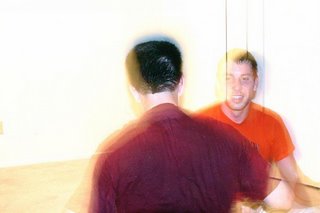
Taking strikes from a sitting position.
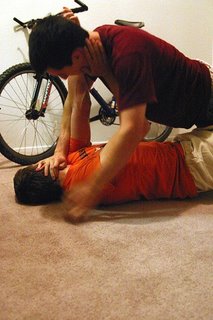
The face mash technique.

Mark probably going for the choke. Me probably not paying attention.

Hitting Mark in the back a bit.
Hopefully I get some pictures of our whole group training soon.

Mark taking a pretty good shot. A little slouchy, but he seems a bit bored by my efforts.

Me rolling around without a care in the world.

Me demonstrating how NOT to take a strike. Bent at the stomach, shoulders caved in. I think he cheated on that one with a feint--look at the devilish grin on his face.

Me facing the consequences of not taking the strike with good form. Breathe...

Apparently my skill increases at the opportunity to touch Mark's ass. Ehh...

Mark snarling for the armbar. Me looking like I'm going to sock him one even though we're just grappling. Oops.

Taking strikes from a sitting position.

The face mash technique.

Mark probably going for the choke. Me probably not paying attention.

Hitting Mark in the back a bit.
Hopefully I get some pictures of our whole group training soon.
Sunday, September 17, 2006
That Object Over There is Invisible
So I wrote a little bit previously about how casual movement doesn't attract attention. We really got a good glimpse of this today while doing some movement work with a four foot staff. The drill was to give one person the stick to swing (slowly) at everyone else. There were only three of us training that day, so the drill stayed pretty clean. One moment I remember distinctly was approaching Gene from behind while he was swinging the staff. We were going very slow, so reflexes weren't an issue (I.e. I'm saying that my bad reflexes have nothing to do this). As I was approaching him to hit him, I saw the staff move over his head and towards me from above. I thought nothing of it--Gene appeared not to be paying any attention to me, which made me presume that any of his movement wouldn't be directed at me. All of a sudden: *thunk*. Wait, how did that stick hit me? I was watching it the whole time. But without picking up on Gene's intent, the movement had no harmful context, "Oh, look, it's just a stick moving towards me, big deal". This could very well be because I'm not too bright at knowing when to get the heck out of the way though. I'm always amused by my malfunctions during training. Running headlong into kicks, ducking a shot to the chest to take it in the neck, trying to redirect a chain using my neck, etc. Maybe I should write about the "invisible effect" when I get over the neural misfires.
Sunday, September 10, 2006
Working with Kids
I had the opportunity to work with a good-sized group of kids (15 or so). I don't have a whole lot of experience when it comes to working with kids, but I know I can be childish, so I didn't figure I'd be terrible at it. I was actually just giving drill ideas to the instructor, Fabian, who relayed them onto the kids. So I had them start off doing rolls, starting from a kneeling position, while holding hands. Kids don't usually have a great fear of the ground, so I figured I could dive right into messier (fun) work--I didn't want to bore them. They seemed to enjoy the rolling, especially rolling backwards. I had them all hold hands to do a big group roll as well, which they actually did really well with. There was only one kid who rolled too late. He kept trying to do everything from a technical standpoint--convinced that he didn't know how to roll very well. I judged the success of the drill by the amount of giggling coming from the rolling mass of kids.
We then practiced some evasion and distance drills, which I figured to be the most boring for them, but I think it's good for developing minds to get just a small taste of the mundane. They started out in pairs, one person striking, and the other evading. From this evasion drill we worked on following the striker, then following and lightly tapping the striker. From here we split the kids into groups of five to work the same concepts but on a mass attack scale. The drill did turn out to be the most boring for them--most of the kids either didn't pay much attention or started horsing around.
Fabian said the final drill should be something fun and involving all of the kids at once. So we created a ring, fifteen feet in diameter, and had Eros stand in the middle. The kids were told to walk quickly towards Eros and hit him twice, walk to the perimeter of the ring, touch one of the bags, walk back to hit him, etc. As they did this, we slowly decreased the diameter of the ring, making the crowd more dense. Pretty soon the perimeter of the circle shrank to about five feet and the kids were getting more rambunctious (I.e. having more fun). I also showed them what relaxation can do by standing in the middle of the crowd while they all pushed on me, then relaxing through the force and having them all fall over. This actually didn't work that well since they just wanted to push me as hard as they could. So after a few unsuccessful attempts (successful for them since they didn't really understand or care what I was trying to demo, they were having too much fun pushing me over), I just relaxed as soon as they started pushing and they all went down. They definitely got a kick out of it, though I think they really just enjoyed pushing me over!
Fabian had them line up again so they could talk about what they learned. A few of the responses were really surprising (unless they were just repeating the overall concepts that they receive in every class--kids past a certain age get that knack for saying what they're taught to say, thanks public schools). Regardless, they seemed to understand some basic principles universal to most martial arts: breathing, going slow to practice and improve movement, footwork, etc.. Working with them was definitely a treat!
We then practiced some evasion and distance drills, which I figured to be the most boring for them, but I think it's good for developing minds to get just a small taste of the mundane. They started out in pairs, one person striking, and the other evading. From this evasion drill we worked on following the striker, then following and lightly tapping the striker. From here we split the kids into groups of five to work the same concepts but on a mass attack scale. The drill did turn out to be the most boring for them--most of the kids either didn't pay much attention or started horsing around.
Fabian said the final drill should be something fun and involving all of the kids at once. So we created a ring, fifteen feet in diameter, and had Eros stand in the middle. The kids were told to walk quickly towards Eros and hit him twice, walk to the perimeter of the ring, touch one of the bags, walk back to hit him, etc. As they did this, we slowly decreased the diameter of the ring, making the crowd more dense. Pretty soon the perimeter of the circle shrank to about five feet and the kids were getting more rambunctious (I.e. having more fun). I also showed them what relaxation can do by standing in the middle of the crowd while they all pushed on me, then relaxing through the force and having them all fall over. This actually didn't work that well since they just wanted to push me as hard as they could. So after a few unsuccessful attempts (successful for them since they didn't really understand or care what I was trying to demo, they were having too much fun pushing me over), I just relaxed as soon as they started pushing and they all went down. They definitely got a kick out of it, though I think they really just enjoyed pushing me over!
Fabian had them line up again so they could talk about what they learned. A few of the responses were really surprising (unless they were just repeating the overall concepts that they receive in every class--kids past a certain age get that knack for saying what they're taught to say, thanks public schools). Regardless, they seemed to understand some basic principles universal to most martial arts: breathing, going slow to practice and improve movement, footwork, etc.. Working with them was definitely a treat!
Subscribe to:
Posts (Atom)